Understand
Read a principle and work through a fictional situation.
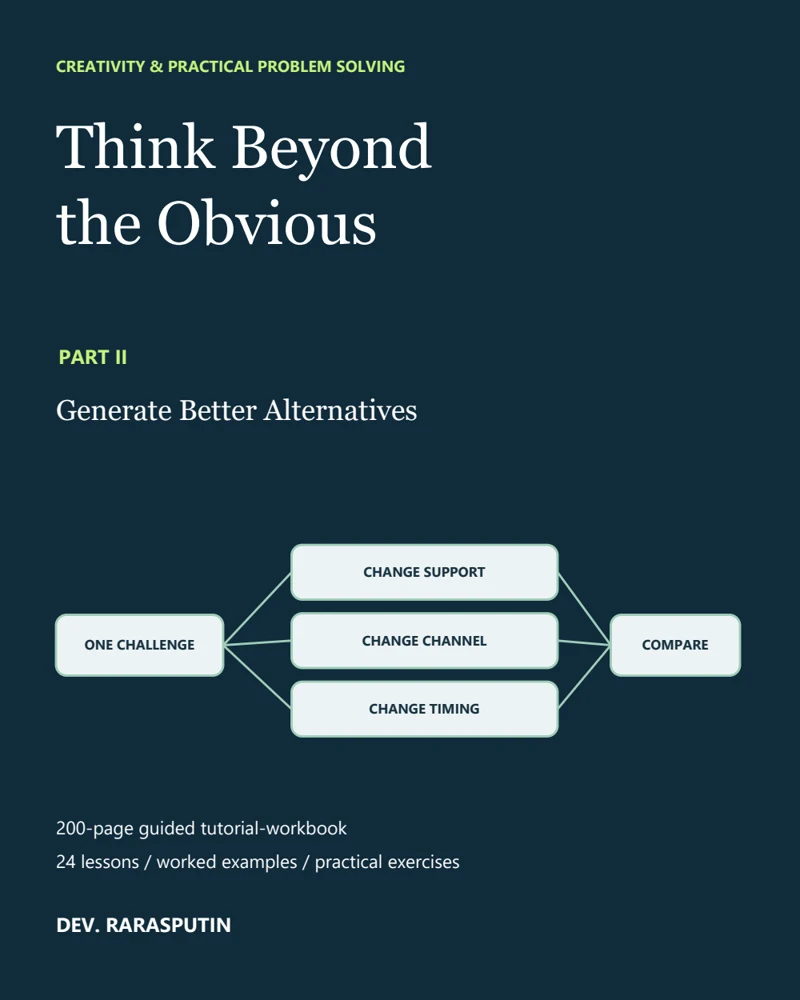
Creativity & practical problem solving / Part II
Expand your options with purposeful creative techniques.
200-page tutorial-workbook / 24 lessons / $5 USD
Publication forthcoming / $5 USD
Substantial guided writing and planning space. PDF plus practical templates; each part is sold separately.
Learn by doing
Read a principle and work through a fictional situation.
Inspect two routes and the assumptions behind them.
Apply the skill to one manageable real challenge.
Record evidence, limits and your next useful decision.
A fictional worked example
Asha rejects every workshop arrival idea because it is not already perfect.
She first records several mechanisms: messages, signs, a greeter and a simple venue map.
The list is a set of candidates, not a commitment to implement them.
Illustrative teaching example, not a testimonial or measured result.
Explore the sample lessonInside this volume
Generating possibilities and judging them are different jobs. A promising idea can be lost if every suggestion is immediately required to prove its feasibility. Use a short generation period, then deliberately return to constraints and evaluation.
Try it: Generate eight possibilities before comparing them.
Check: Did you judge the idea before recording what it was?
Ten versions of a poster may represent one mechanism rather than ten alternatives. Compare how each idea would produce the outcome. Seek differences in timing, channel, responsibility or sequence, not only cosmetic variation.
Try it: Create one alternative for each of five different mechanisms.
Check: Which options would fail for different reasons?
Writing privately before discussion gives people time to form a thought without competing for the floor. It also preserves options that might disappear after a confident first speaker. Sharing follows the writing period.
Try it: Try a short silent round alone or with willing collaborators.
Check: What appeared before people heard the first public suggestion?
Name what the proposed object must do, then find different ways to perform that function. Delivering information, confirming understanding and granting access may require different mechanisms. Avoid treating one familiar object as indispensable.
Try it: Take one favorite object and list the functions behind it.
Check: Which function has only one imagined implementation?
Substitution changes one part of a familiar arrangement while holding the purpose steady. Replace a channel, material, role or timing, then inspect what improves and what is lost. The replacement is a proposal to examine.
Try it: Generate five substitutions for one component.
Check: What must the replacement still enable?
Combining helps when two ideas solve different parts of the same need. Explain the contribution of each instead of stacking features. Check whether the combination adds coordination or maintenance costs.
Try it: Combine two ideas and name what each contributes.
Check: What extra burden does the combination create?
An analogy transfers a useful relationship from another setting. Identify the mechanism, then ask whether its conditions exist in your problem. Borrowing the surface appearance alone rarely explains why an idea might help.
Try it: Find a pattern in transport, kitchens or libraries and map its mechanism.
Check: Which condition differs between the two settings?
Enlarging, shrinking or dividing an idea can reveal a different way to meet the need. Change the scope intentionally and inspect the trade-off. A smaller version is not automatically sufficient.
Try it: Create miniature, ordinary and expanded versions of one idea.
Check: What becomes possible or impossible at each scale?
Elimination asks whether a step, field or meeting exists for a necessary purpose. Remove one component on paper and trace the consequences. Restore or replace any essential function before trying the change.
Try it: Choose one process step and explain who uses its output.
Check: Who would notice that the removed component is missing?
Reversing asks what happens if an activity occurs earlier, later or in the opposite order. It can reveal dependency assumptions. Some sequences protect quality or safety and cannot be casually reversed.
Try it: Generate three reordered versions of a simple low-risk process.
Check: Which dependency makes the original order necessary?
A temporary resource limit can move thinking away from buying more tools. Specify what remains available and keep the intended outcome visible. Later, remove the limit and compare the resulting ideas fairly.
Try it: Generate alternatives using only tools already available.
Check: Which idea appeared only because the usual purchase was unavailable?
Inversion imagines how to make the difficulty worse, then translates those conditions into prevention or improvement ideas. Keep the exercise on paper. The opposite of a bad practice is a clue rather than a guaranteed solution.
Try it: Write five failure-producing conditions and their constructive implications.
Check: Which inverted idea addresses an observed cause?
An unrelated word or object can interrupt familiar associations. Explain a plausible connection to the challenge rather than forcing nonsense into a proposal. Keep the cue as a generator, not evidence.
Try it: Use three everyday objects to prompt different mechanisms.
Check: Can you explain the connection without relying on novelty alone?
A combination grid lists alternative choices for different dimensions of a solution. It helps you explore configurations systematically. Exclude combinations whose parts contradict one another.
Try it: Build a three-dimension grid with at least two options in each.
Check: Which combinations are internally compatible?
Developing someone else's idea should add a function, solve a limitation or reveal a new context. State the contribution so the original author can recognize what changed. Give credit when sharing the idea.
Try it: Develop an existing idea with one explicit improvement.
Check: What useful capability did your contribution add?
An idea ledger preserves the original suggestion, its purpose and its open questions. It makes it easier to combine or revisit options without relying on memory. Keep rough ideas separate from approved actions.
Try it: Record ten ideas in one sentence each with a mechanism label.
Check: Could someone understand the idea without the original conversation?
A new viewpoint can expose a practical condition the current group has missed. Ask a specific person about their actual experience rather than asking them to represent an entire category of people.
Try it: Name one relevant perspective absent from your current pool.
Check: Which assumption changed after hearing that perspective?
Immediate, next-week and longer-term versions reveal different possibilities. State which horizon each idea serves. A temporary workaround may be appropriate while a structural change is investigated.
Try it: Create three horizon-specific responses to one problem.
Check: When should the temporary option be reviewed?
When a product idea stalls, consider a change in service, responsibility or interaction. Some needs are met by coordination rather than a new object. Include the labor required in the concept.
Try it: Find two human-supported and two self-service approaches.
Check: Who performs the ongoing work in each alternative?
A storyboard describes the person's sequence before, during and after an interaction. It reveals gaps that a feature list can hide. Stick figures and plain captions are sufficient.
Try it: Draw four moments and caption what the person does in each.
Check: Where does the person need information they no longer have?
A surprising idea deserves enough development to reveal its mechanism before rejection. Ask what useful principle it contains, then create a realistic version. You can still reject it after the inspection.
Try it: Choose an odd idea and extract a workable principle.
Check: What useful relationship survives after the exaggeration is removed?
Clustering organizes related ideas while keeping meaningful variants visible. Label the organizing rule. If one group contains unlike mechanisms, split it rather than forcing tidy categories.
Try it: Sort your ledger and write a sentence describing each cluster.
Check: What distinction would disappear if this cluster became one idea?
Repetition can signal a narrow frame, fatigue, missing information or a technique that no longer helps. Diagnose the obstacle and change the next action. Generating indefinitely is not a sign of creativity.
Try it: Identify why your latest ideas resemble the first ones.
Check: What new input would make the next round different?
A useful portfolio retains a small variety of coherent candidates and their mechanisms. It includes open questions and a reference to the original brief. Selection can then compare alternatives fairly.
Try it: Create four concept cards with the same headings.
Check: Does the portfolio contain meaningfully different ways to reach the outcome?
Your working space
Choose a lesson, describe your challenge and keep the reasoning visible. Save stores entries in this browser only. Download a copy for another device. There is no account or cloud sync.
The complete learning path
Each volume contains 200 numbered pages, including substantial practice and writing space. This is a tutorial-workbook series, not a video course or interactive PDF form. Ordinary examples are fictional. Results depend on context, judgment and practice.